IK Impact and IP Testing for LED Lights
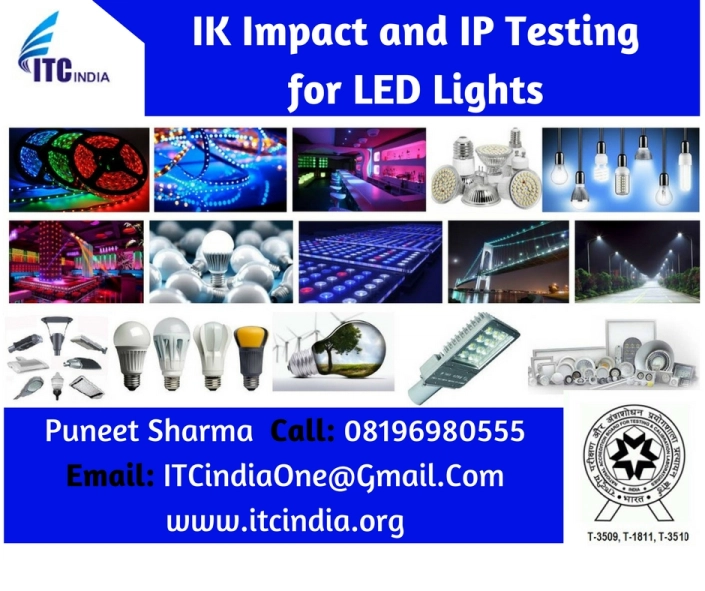 IK Impact and IP Testing for LED Lights
If you are looking for IK Testing Laboratory for LED Lighting In your Area, ITCIndia Electrical Safety testing Laboratory Approved from NABL. ITC India one of the best IK Impact Testing Laboratory in India, Mumbai, Chennai, Ahmedabad, New Delhi, Pune, Kolkata, Bangalore, Hyderabad, Surat, Visakhapatnam.
ITCIndia “Institute of Testing and Certification India Pvt. Ltd” are a leading testing lab having a NABL accreditation under ELECTRICAL, ELECTRONICS and PHOTOMETRY testing with certificate no. T-3509, T-3570 and T-1811. ITCIndia Lab is following the procedure as required by International Standard IEC 17025 and is already certified for ISO/IEC 17025.
ITCIndia offers full IK Impact and IP Testing and certification services for LED Lighting luminaires to IEC 60598-2-3 Impact IK ratings are defined as IKXX, where “XX” is a number from 00 to 10 indicating the degrees of protection provided by electrical enclosures including luminaires against external mechanical impacts. The Impact IK rating scale identifies the ability of an enclosure to resist impact energy levels measured in joules. IEC 62262 specifies how the enclosure must be mounted for IK Impact and IP Testing, the atmospheric conditions required, the quantity and distribution of the test impacts and the impact hammer to be used for each level of Impact IK rating.
Standards for IK Impact and IP Testing for LED Lighting
IEC 62262 specifies the way enclosures should be tested for IK ratings which are defined as the level of protection the enclosures provided against external mechanical impacts. IEC 60598-1 (IEC 60529) specifies the test method used to classify and rate the degree of protection an enclosure provides against intrusion of various sized solid objects from fingers and hands to fine dust and the protection against water intrusion from falling drops to a high pressure water jet.IEC 60598-2-3 is the International Standard for Luminaires for Road and Street Lighting
| Degrees of protection against external mechanical impacts | ||||||||
| IK00 | IK02 | IK03 | IK05 | IK06 | IK07 | IK08 | IK09 | IK10 |
| Non-protected | 0.2J | 0.35J | 0.5J | 0.7J | 1J | 2J |5J | 10J | 20J |
IP ratings are defined as IPXX where the first X indicates the degree of protection against solid objects and the second X indicates the degrees of protection against water. A luminaire or lighting component with a rating of IP66 is dust-tight and protected against powerful water jets as described in IEC 60598-1 (IEC 60529).
| Degrees of protection against solid objects | |
| IP0X | Non-protected |
| IP1X | 50mm diameter and greater |
| IP2X | 12.55mm diameter and greater |
| IP3X | 2.5mm diameter and greater |
| IP4X | 1.0mm diameter and greater |
| IP5X | Dust-protected |
| IP6X | Dust-tight |
| Degrees of protection against water | |
| IPX0 | Non-protected |
| IPX1 | Vertically falling water drops |
| IPX2 | Vertically falling water drops with enclosure tilted |
| IPX3 | Spraying water |
| IPX4 | Splashing water |
| IPX5 | Water jets |
| IPX6 | Powerful water jets |
| IPX7 | Temporary immersion |
| IPX8 | Continuous immersion |
IK Impact and IP Testing for LED Lighting Products Ratings that demonstrate the degree of Impact Protection IK Impact and Ingress Protection are critical for LED Lights and other LED lighting products. IP ratings are required per IEC/EN 60598-2-3 for all roadway and street applications. Impact IK ratings are required in specific applications when high impact glass provides protection for the enclosed lamp
If you’re Buyers Demanding for IK Testing– Contact Now!
Wish this blog post will be help. If you have any other questions, please feel free to contact us. ITCIndia team looking forward work with you and get better together!
Mr. Puneet Sharma | Call: 08196980555 | E-mail: [email protected]
Get Instant Quotations, Fill the Enquiry form:
What are LM 79 Test Outcomes?
What are LM 79 Test Outcomes?
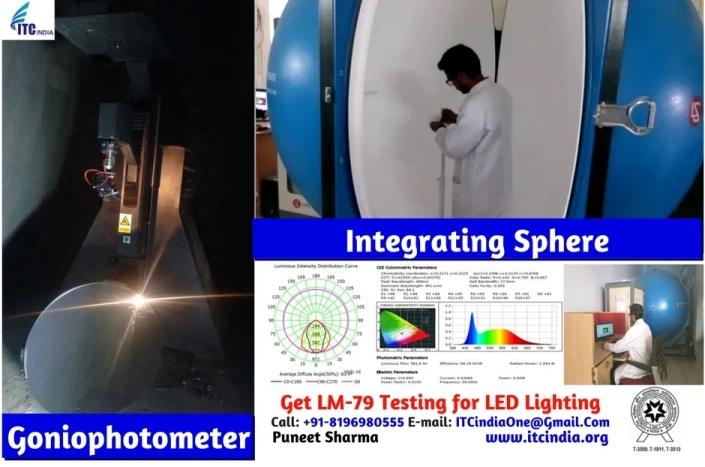
LM-79 is approved test method for electrical and photometric measurements of Solid State Lighting Products. It describes the procedure in measuring total luminous flux, electrical power, luminous intensity distribution, chromaticity under standard conditions. It covers LED based SSL products with control electronics and heat sink incorporated with AC or DC power supply. This does not include LED chips, LED package or LED module but luminaries (fixtures incorporating light source) as well as integrated LED lamps.
The equipment used in LM-79 is integrated sphere and goniophotometer.
Integrating Sphere Goniophotometer
The test report shall list all significant data for each SSL product tested together with performance data. The outcomes of the LM-79 test are:
- Correction factor applied ( e.g. spectral mismatch, self absorption , intensity distribution etc.)
- Measured total luminous flux( lumen(lm)), input voltage(v), current(a), power(w), Luminous intensity distribution(cd), efficacy(lm/w)
- Color quantities( chromaticity coordinates, CCT, CRI )
- Spectral power distribution
- Bandwidth of spectoradiometer, if spectral distribution and/or color quantities are reported.
- Statement of uncertainties (if required)
- Deviation from standard operating procedures, if any.
Here is the link of a test report issued by our prestigious company. LM 79 Test Outcomes
If you’re Buyers Demanding for LM-79 Testing– Contact Now!
Wish this blog post will be help. If you have any other questions, please feel free to contact us. ITCIndia team looking forward work with you and get better together!
Mr. Puneet Sharma | Call: 08196980555 | E-mail: [email protected]
Get Instant Quotations, Fill the Enquiry form:
Q:- What is RoHS standard?
Q:- What is RoHS standard?
RoHS is a Directive issued by European Union. The New Directive of RoHS was published in July 2011 and is popularly known as RoHS2. The new Directive is published as official European legislation 2011/65/EU and will replace previous legislation.
From 22nd July 2014 the substance restrictions will gradually be extended to new product categories. The provisions of RoHS 2 will also apply for these types of EEE5 from the dates mentioned below:

The six hazardous and restricted substances in the RoHS2 directive are outlined in Annex II (page L174/100) with maximum concentration values tolerated by weight to homogeneous materials.
| Hazarduous substance | by weight in all homogeneous materials |
| Lead | 0.1% |
| Mercury | 0.1% |
| Cadmium | 0.01% |
| Hexavalent Chromium | 0.1% |
| Polybrominated biphenyls | 0.1% |
| Polybrominated diphenyl ethers | 0.1% |
Q:- What does it mean to be Rohs compliant?
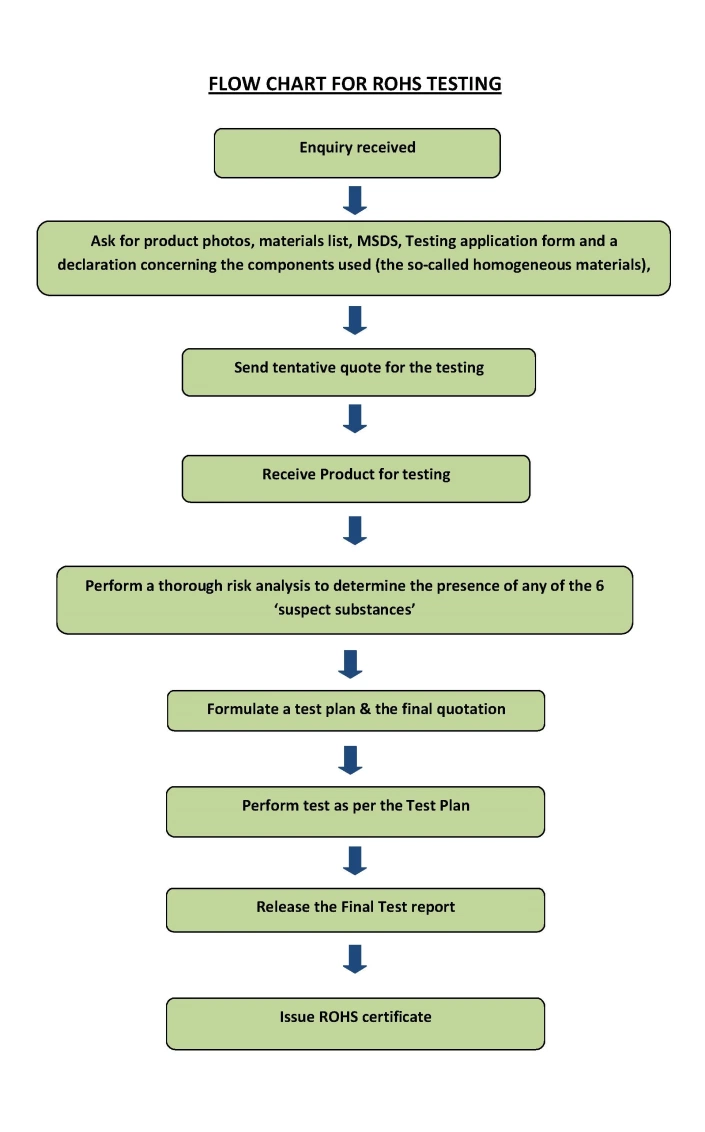
It means that the manufacturer or the person placing the electrical and electronic product in the market should have by testing made sure that
Q:- How is the testing of RoHS done in your laboratory?
Testing is carried out as per harmonised standards in our laboratory
EN 50581:2012 _ this standard specifies the Technical documentation that should be compiled by a manufacturer of electrical and electronic product ·
IEC/TR 62476 Edition 1.0 gives detailed guidance for evaluation of products with respect to substances – ·
IEC/PAS 62596:2009 gives guideline for sampling
EN 62321: 2009 Electrotechnical products – Determination of levels of six regulated substances (lead, mercury, cadmi- um, Hexavalent chromium, Polybrominated biphenyls, Polybrominated diphenyl ethers).
EN 62474:2012 Material declaration for products of and for the Electrotechnical Industry
Q:- Are solar panels and wind turbines within the scope of RoHS?
Solar panels ar excluded from RoHS
Q:-Does packaging used for a product need to comply with RoHS regulations?
NO packaging used for a product need not comply with RoHS regulations
Q:-Are LEDs within the scope of RoHS?
Yes, LED and all lightings are very much covered by RoHS 2
If you’re Buyers Demanding for RoHs Testing– Contact Now!
Wish this blog post will be help. If you have any other questions, please feel free to contact us. ITCIndia team looking forward work with you and get better together!
Mr. Puneet Sharma | Call: 08196980555 | E-mail: [email protected]
Get Instant Quotations, Fill the Enquiry form:
What is LM 79 Test methodology?
What is LM 79 Test methodology?
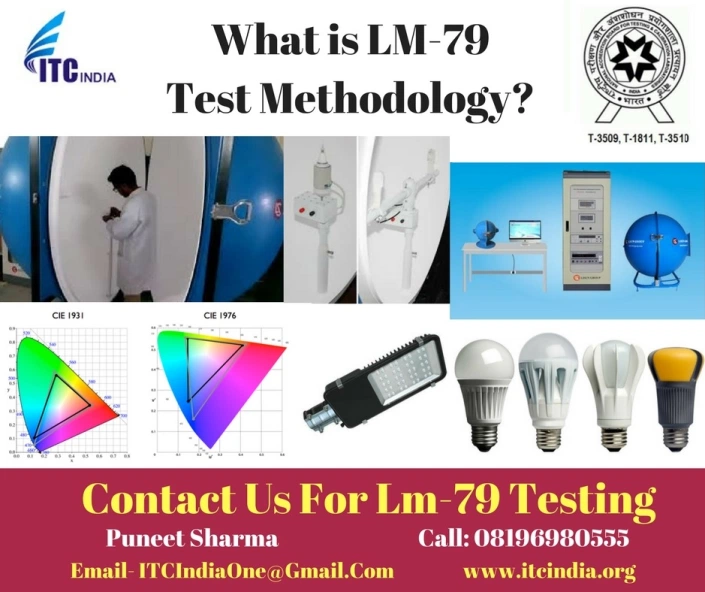
LM 79 is an approved method that describes the procedure to be followed and precautions to be observed in performing reproducible measurements of total Luminous flux, electrical power, luminous intensity distribution, chromaticity of Solid-State lighting products for illumination purposes under standard conditions.
LM 79 covers- LED based SSL products with control electronics and heat sinks. Luminaries (fixtures incorporating light source) as well integrated LED lamps.
LM 79 doesn’t cover– fixtures without a light source, SSL products that require external operating.
LM 79
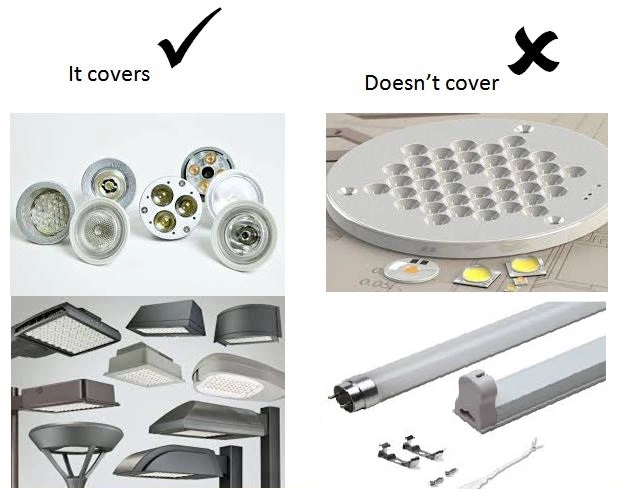
Test method for total luminous flux Measurements:
The total luminous flux of SSL product shall be measured with an Integrating Sphere or Goniophotometer. The method may be chosen depending upon what other measurements quantities (color, intensity distribution) need to be measured., the size of SSL products, and other requirements.
The integrating sphere is suited for total luminous flux and color measurements of integrated LED lamps and relative small size LED luminaries. Advantage of using integrating sphere is that it does not requires the “ Dark Room”., and also it is less time consuming.
The Goniophotometer provides measurements of Luminous Intensity Distribution as well as total luminous flux. It can take measurements of larger size luminaries as well as small size luminaries. It has to be installed in Dark Room. Measurements in goniophotometer are time consuming.
| Integrating Sphere | Goniophotometer | |
| Conditions | No Dark room | Dark Room |
| Size of SSL | Small Size luminaries | Large size as well as small size Luminaries |
| Measurements | Total Luminous Flux | Light Intensity Distribution , Total Luminous Flux |
| Duration of Test | Fast Measurements | Time consuming as compared to Sphere photometer. |
If you’re Buyers Demanding for Luminaries Testing– Contact Now!
Wish this blog post will be help. If you have any other questions, please feel free to contact us. ITCIndia team looking forward work with you and get better together!
Mr. Puneet Sharma | Call: 08196980555 | E-mail: [email protected]
Get Instant Quotations, Fill the Enquiry form:
How LM-79 testing can help assess LED luminary quality and performance?
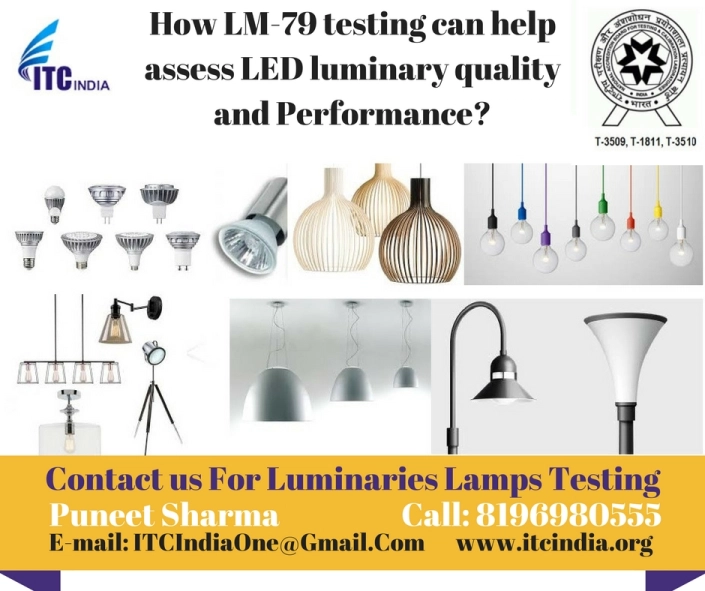
How LM-79 testing can help assess LED luminary quality and performance?
We all believe in buying quality products. Discovery of LED is boon to our world. LED has replaced all the traditional lightning systems because of its quality, life and performance. Manufacturers are switching from manufacturing traditional lightning to produce LED lighting. Many of the manufacturers are making unsubstantial claims regarding colour quality, luminous flux (lm), efficacy (lm/w) and general quality. This can Lead to LED degradation. To ensure quality, a series of test has to be performed on LED luminaries for its long term survival. This is served by LM 79 test method. It is not only the LED but the whole SSL has to qualify all the tests.
For special purpose, it may be useful to determine the characteristics of SSL products when they are operated at other than standard conditions described in the approved method.
Photometric testing includes measurements of total radiant flux, luminous flux, Efficacy (lm/w), chromaticity, correlated color temperature (CCT), and color rendering index (CRI), Light Intensity Distribution (cd). Radiant flux, expressed in watts, is a measurement of the total power of electromagnetic radiation (light) emitted from the luminary or lamp. Luminous flux is a weighted measurement based on human visual perception.
The above measured parameters help to access the LED luminary quality and performance.
ITC india Pvt Ltd is a leading company to test LM 79, company has both the highly accurate equipments “The Integrating Sphere” & “ The Goniophotometer” installed at its premises.
ITC india is a NABL accredited lab having full scope of LM 79( certificate no. T-3510.)
If you’re Buyers Demanding for LED Luminaries Lamps Testing– Contact Now!
Wish this blog post will be help. If you have any other questions, please feel free to contact us. ITCIndia team looking forward work with you and get better together!
Mr. Puneet Sharma | Call: 08196980555 | E-mail: [email protected]
Get Instant Quotations, Fill the Enquiry form:
How to Check LED Star Rating?
If you are looking for LED Star Rating Testing Laboratory for LED Lighting In India, ITCIndia NABL Approved Laboratory Approved.
What is ENERGY star label means?
The motive of the energy stars is to help humans and organization to save money and emission of green house gasses. Any structure or product that got the energy star receives the blue logo as shown above.
It is very important to adopt the energy efficient practices, to lower the operational cost and to reduce pressure on energy grid. It will definitely reduce the global warming, a result of emission of green house gases like CO2.
BY adopting the energy star logo, we can contribute to save our ecosystem.
The energy consumption varies with products, for example a 500 lts refrigerator will consume, 1 star rated model would have annual consumption of about 490 units, 2 star would have about 380 units and 3 star would have about 290 units.
What is ENERGY star qualified?
Energy star qualification is to achieve common goal to protect the environment for our future to adopt more and more energy efficient appliances
Energy star qualified means that the appliances (with energy star logo) uses 10 -50 % less energy as compared to other appliances.
Innumerable reasons can be given for the usage of energy star appliances……..
- Lower the utility bills or pocket friendly
- Better quality and durability
- Enhanced performance
Energy star is a symbol of energy efficiency. It defines new homes, buildings, appliances and many more products. Products that can earn ENERGY stars are windows, refrigerators, Air Conditioner, Geysers, Bulbs, Tube light and house hold appliances.
What is ENERGY star Program?
Energy star is program initiated by U.S environment Protection Company with an aim to save and protect the environment form the harmful green house gasses in future. Use of Automobiles, Air conditioners, refrigerators and many heat generating equipment’s has increased the emission of green house gases hence increased the global Warming.
So, to protect the environment, ENERGY star program has been introduced to promote the use of energy efficient appliances to reduce the emission of green house gasses.
Now the ENERGY star Label can be obtained on new home , building, Electric appliances, lightning, home appliances, office equipment’s, IT and many more.
What is Star Rating?
Star rating is not a measure of power used. They are a relative measure of how efficiently the power is used. It is rated between 1- 5 stars. More the number of rated stars, more energy efficient. 1 star is less energy efficient than 2 star than 3 star than 4 star than 5 star.
What is LED star rating?
Today is the scenario of LED lighting. Benefits of LED, made the world switch to use LED lights instead of traditional lightning.
Due to the problem of the manufacturer, tapping to this lucrative business but compromising on the quality, the star rating on the LED lightning is soon coming to help people.
LED rating depends on two factors:
Watt: It defines the energy consumption of the LED and lumen per watt: It defines the amount of light produced in a unit power. Lumen per watt is the measure of energy efficiency.
Here is a table which shows the rating of the LED
| Lumen per watt | Rating |
| Less than 80 | 1
|
| 79-90 | 2
|
| 90-104 | 3 |
| 105-120 | 4 |
| More than 120 | 5 |
