Q:- Which Motor is Used in Electric Traction?
A. Synchronous motor.
B. DC series motor.
C. Reluctance motor.
D. Induction motor.
Thermal Testing for LED Lights
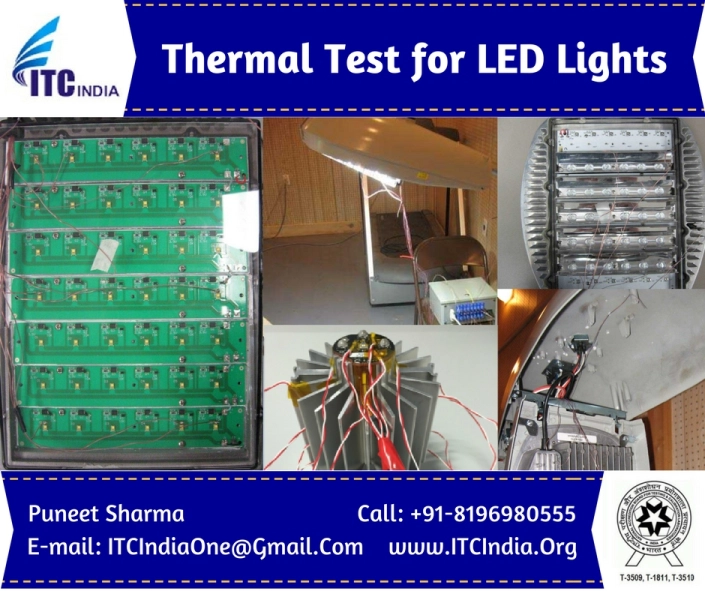
Thermal Testing for LED Lights, Thermal Testing of LEDs, Thermal testing of road luminaires
If you are looking for Thermal Testing Laboratory for LED Lighting In your Area, ITCIndia NABL Approved Electrical Safety testing Laboratory In India. ITC India one of the best Thermal Testing Laboratory in India, Mumbai, Chennai, Ahmedabad, New Delhi, Pune, Kolkata, Bangalore, Hyderabad, Surat, Visakhapatnam.
ITCIndia “Institute of Testing and Certification India Pvt. Ltd” are a leading testing lab having a NABL accreditation under ELECTRICAL, ELECTRONICS and PHOTOMETRY testing with certificate no. T-3509, T-3570 and T-1811. ITCIndia Lab is following the procedure as required by International Standard IEC 17025 and is already certified for ISO/IEC 17025.
Thermal test is one of the important tests while testing LED luminaries, so we would like to have its basic knowledge.
Thermal test is performed for normal and abnormal conditions. We will peep inside both the conditions respectively.
The motive of thermal test is that the Lamp, part of the luminary, supply wiring, mounting surface should not attain the temperature which can cause injury. The parts like handles should not be too hot to be touched. Same scenario is for the track mounted luminaries are there. Track mounted Luminaries are tested as per clause 12.4.1. Draught proof chamber is specially designed for this particular test. While performing the test, the through wiring and the looping in wiring shall be loaded to the maximum value allowed by the size of the wire, or at a value prescribed by the manufacturer in the installation instructions.
After the test, none of the temperature shall exceed the values given in table 12.1 & 12.2 of IEC 60598-1.
While performing the thermal test in abnormal condition, luminaries are tested in abnormal conditions. The temperature shall not exceed as mentioned in table 12.3, 12.4, and 12.5. If the luminary possesses motor, the test is performed in most critical condition.
Clause 12.6 is applied to the luminary classified for mounting on normally flammable surfaces with a control gear. Clause 12.7 is thermal test in regard to fault conditions in lamp control gear or electronics devices incorporated in thermoplastics luminaries.
Temperature Measurement Data as per client specification
The sample was operated until constant temperatures were obtained. A temperature was considered
constant if the sample was operating for at least three hours and upon three successive readings – taken at
15 minute intervals – were within one degree and were not rising.
Thermocouples were attached at locations described in the results by means of cement made of water
Table-1
| No. of LED’s: | 48 | Ambient Temperature: | 25°C ± 1°C | ||
| Total no. of test points: | 55 | No. of Rows | 4 | ||
| Sr. no. | Measured Temperature at Pt. | Measured Temperature | |||
| Row-1 | |||||
| 1 | LED 1 (Ts) | 56.3 | |||
| 2 | LED 2 (Ts) | 56.7 | |||
| 3 | LED 3 (Ts) | 55.8 | |||
| 4 | LED 4 (Ts) | 55.1 | |||
| 5 | LED 5 (Ts) | 56.4 | |||
| 6 | LED 6 (Ts) | 55.9 | |||
| 7 | LED 7 (Ts) | 55.2 | |||
| 8 | LED 8 (Ts) | 57.1 | |||
| 9 | LED 9 (Ts) | 57.4 | |||
| 10 | LED 10 (Ts) | 56.6 | |||
| 11 | LED 11 (Ts) | 56.9 | |||
| 12 | LED 12 (Ts) | 57.2 | |||
| Row- 2 | |||||
| 13 | LED 13 (Ts) | 54.6 | |||
| 14 | LED 14 (Ts) | 55.8 | |||
| 15 | LED 15 (Ts) | 57.6 | |||
| 16 | LED 16 (Ts) | 57.9 | |||
| 17 | LED 17 (Ts) | 55.5 | |||
| 18 | LED 18 (Ts) | 57.4 | |||
| 19 | LED 19 (Ts) | 56.9 | |||
| 20 | LED 20 (Ts) | 57.6 | |||
| 21 | LED 21 (Ts) | 56.5 | |||
| 22 | LED 22 (Ts) | 57.5 | |||
| 23 | LED 23 (Ts) | 56.3 | |||
| 24 | LED 24 (Ts) | 56.9 | |||
| Row -3 | |||||
| 25 | LED 25 (Ts) | 55.5 | |||
| 26 | LED 26 (Ts) | 54.9 | |||
| 27 | LED 27 (Ts) | 55.9 | |||
| 28 | LED 28 (Ts) | 56.0 | |||
| 29 | LED 29 (Ts) | 56.3 | |||
| 30 | LED 30 (Ts) | 55.9 | |||
| 31 | LED 31 (Ts) | 56.2 | |||
| 32 | LED 32 (Ts) | 54.3 | |||
| 33 | LED 33 (Ts) | 55.2 | |||
| 34 | LED 34 (Ts) | 55.9 | |||
| 35 | LED 35 (Ts) | 56.3 | |||
| 36 | LED 36 (Ts) | 56.8 | |||
| Row- 4 | |||||
| 37 | LED 37 (Ts) | 55.5 | |||
| 38 | LED 38 (Ts) | 55.9 | |||
| 39 | LED 39 (Ts) | 56.1 | |||
| 40 | LED 40 (Ts) | 57.5 | |||
| 41 | LED 41 (Ts) | 56.2 | |||
| 42 | LED 42 (Ts) | 55.9 | |||
| 43 | LED 43 (Ts) | 57.2 | |||
| 44 | LED 44 (Ts) | 57.7 | |||
| 45 | LED 45 (Ts) | 57.3 | |||
| 46 | LED 46 (Ts) | 56.9 | |||
| 47 | LED 47 (Ts) | 57.5 | |||
| 48 | LED 48 (Ts) | 57.8 | |||
| TP Point Pcb -1 | |||||
| 1. | TP | 56.5 | |||
| TP Point Pcb -2 | |||||
| 1. | TP | 55.6 | |||
| TP Point Pcb -3 | |||||
| 1. | TP | 55.9 | |||
| TP Point Pcb -4 | |||||
| 1. | TP | 56.1 | |||
| TP Point Pcb -5 | |||||
| 1. | TP | 56.2 | |||
| TP Point Pcb -6 | |||||
| 1. | TP | 56.9 | |||
| Ballast Tc Test point | |||||
| 1. | Tc | 53.4 | |||
ITC India Pvt. Ltd. is accompanying which possesses the full scope of IEC 60598-1. For any query please write us at …..
If you’re Buyers Demanding for Thermal Testing– Contact Now
Wish this blog post will be help. If you have any other questions, please feel free to contact us. ITCIndia team looking forward work with you and get better together!
Mr. Puneet Sharma | Call: 08196980555 | E-mail: [email protected]
Get Instant Quotations, Fill the Enquiry form:
What are the limitations of LM-79?
What are the limitations of LM-79?
As we all know about the strength of LM 79. Everything has its pros and cons. Let us have a look on the drawbacks of LM 79.
- LM 79 depicts the parameters of the individual products. So the obtained Parameters cannot be used to access alike products.
- Other limitation is the sample size. It does not state any sample size. So, the manufacturer provides only one sample instead of supplying more. This thus increases the vulnerability of lesser quality products.
- This can be used only to determine complete luminary instead of LED used ( as based on absolute photometry) , which can produce different results due to quality of accessories used like glass, thermal effect, lenses etc.
If you’re Buyers Demanding for LM-79 Testing– Contact Now!
Wish this blog post will be help. If you have any other questions, please feel free to contact us. ITCIndia team looking forward work with you and get better together!
Mr. Puneet Sharma | Call: 08196980555 | E-mail: [email protected]
Get Instant Quotations, Fill the Enquiry form:
What is IEC 60601-1?
What is IEC 60601-1?
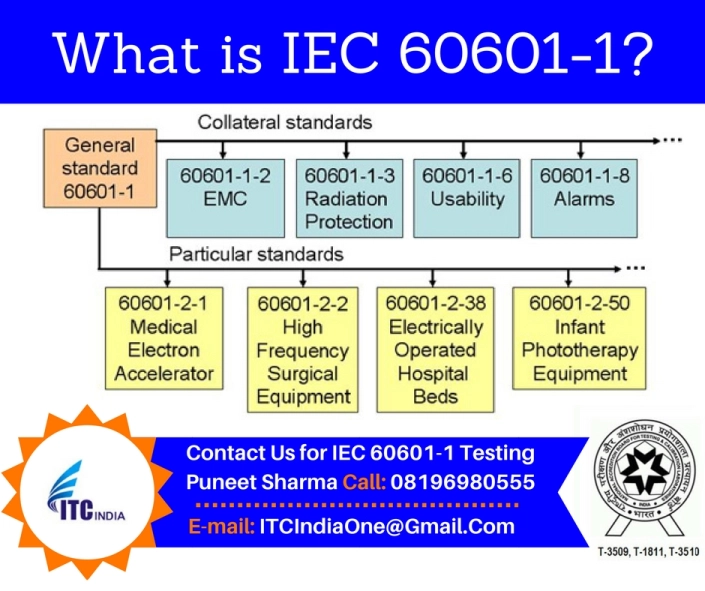
Standards play a paramount role in product design and development. IEC 60601-1 is a series of technical standards for the safety and effectiveness of medical electrical equipment. The force of this standard is to require two level of protection to guard the patient and operator from any injury. It is recognized worldwide. This standard is of four parts:
- Base standard: General requirements for basic safety and essential performance. IEC 60601-1
- Collateral standards: Generally numbered as IEC 60601-1-) for example IEC 60601-1-11 General requirement for basic safety and essential performance collateral standard requirement for medical electrical equipment and medical electrical system used in the home health care environment.
- Particulate standards: They are numbered as IEC 60601-2-) for example IEC 60601-2-52 particular requirement for the basic safety and essential performance of medical beds.
- Performance standards: Generally numbered as IEC 60601-3-
Essential performance requirement for transcutaneous oxygen and carbon dioxide partial pressure monitoring equipment.
If you’re Buyers Demanding for IEC 60601-1 Testing – Contact Now!
Wish this blog post will be help. If you have any other questions, please feel free to contact us. ITCIndia team looking forward work with you and get better together!
Mr. Puneet Sharma | Call: 08196980555 | E-mail: [email protected]
Get Instant Quotations, Fill the Enquiry form:
What is Relative Photometry?
What is relative photometry?
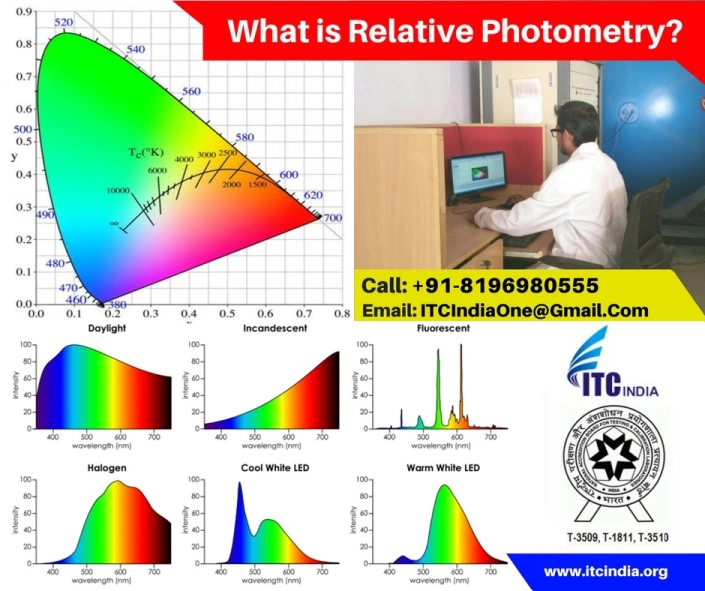
Total Lumen output of a bare lamp is measured in relative photometry for more clarity; the total luminous flux of the lamp is measured separately without the Fixture. In IES LM-80- 08, IES LM 82-12, the relative photometry is used. The purpose is to find light output, Efficacy, color over temperature for light engines.
Relative photometry can measures:
- Total luminous flux of the bare lamp
- Luminous intensity distribution
- Scale the luminous intensity values by the ratio of the measured lamp lumens to the rated lamp lumens.
Some important features regarding relative photometry:
- Relative photometry is performed for luminaries with conventional sources.
- Luminaries test is referenced to the luminous Flux measured for bare lamp.
- The result produced is in the units of candela per rated lumens( cd/rated lm)
- It can also measure the efficiency of luminary.
- Normalize ballast factor, Lamp age.
- Specific lamp performance doesn’t matter
Relative photometry is not used in SSL with integrated lamps due to many reasons:
- The LED‘s are difficult to remove from the Luminaries.
- A large number of LED devices will not work properly without heat sinks provided with luminaries.
- The thermal environment that the LED devices undergo within the luminary is often radically different from the thermal environment it will practice in its “bare lamp” configuration.
